


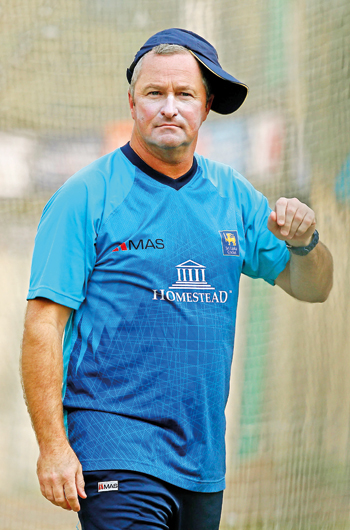
Paul Farbrace was assistant coach to Trevor Bayliss from 2007 to 2009, and was Sri Lanka’s Head Coach briefly when the team lifted the 2014 T20 World Cup
For years, Sri Lankan cricket has been caught between professionalism and politics. Coaches have changed, captains were appointed and discarded at the drop of a hat, and selectors have come and gone, but one thing remains constant: the interference from outside the dressing room. This conversation has now been reopened by Paul Farbrace, a former Sri Lanka coach whose revealing comments during a recent interview with the Murali End expose how deeply politics has seeped into the national team’s decision-making process.
Farbrace, who was assistant coach to Trevor Bayliss from 2007 to 2009, was Sri Lanka’s Head Coach briefly when the team lifted the 2014 T20 World Cup. He reflected on his frustrations during his stint with Sri Lanka, particularly when it came to selection matters. His comments were not surprising to those familiar with the inner workings of Sri Lankan cricket. It was a confirmation of a dark reality many have whispered about for years.
“There were several occasions where political or administrative interference made things difficult,” Farbrace said.
“Dilshan, for example, wasn’t originally picked for that Australia tour either, which, looking back, seems incredible because if you wanted someone to bat for your life in Australia, Dilshan was exactly the sort of player you wanted. There were moments where ministers intervened before games as well.”
His comments revive memories of when politicians, players and powerful administrators allegedly heaped pressure, including over selection, captaincy appointments and finalising squad composition. He revealed how two senior players being “parachuted” into the touring side before Australia in 2007 exemplified a system where selectors were often overruled by political authority. Interference is so normalised over the years that many within the system learned to adapt. While leading cricket nations operate with clearly defined professional structures, Sri Lanka frequently broke those boundaries. Selectors are appointed to pick players on merit with a broader outlook in their mind, yet their authority often existed only on paper.
It’s no secret that board presidents, sports ministers and influential politicians, including heads of state, had their own ‘recommendations’ and in some cases those suggestions, like mentioned by Farbrace, had the weight of instructions. And when one refuses to cooperate with administrative agendas, one risks becoming expendable. So, many have fallen in line, refusing to walk straight with their heads held high.
Even under the previous administration headed by Shammi Silva, accusations of interference never truly disappeared. While Sri Lanka Cricket publicly maintained that selectors operated independently, it’s no secret that they worked under immense boardroom pressure.
This culture has contributed significantly to Sri Lanka’s current struggles in international cricket. While talent remains abundant, the system managing that talent has often been unstable and directionless. Frequent leadership changes, inconsistent selection policies and politically motivated decisions have prevented the team from building continuity. The best example was the change of T20 captaincy just months ahead of the T20 World Cup, having already built the team around Charith Asalanka for over one-and-a-half years.
That is why the current move towards handing white ball leadership responsibilities to Kusal Mendis could prove to be a crucial turning point, provided it is handled professionally and without interference.
Mendis has matured considerably over the past few years. Once regarded as an immensely gifted but volatile cricketer, he now appears far more composed both on and off the field. His batting has become responsible, his body language more assured and his influence within the dressing room increasingly evident. At present, he is arguably among Sri Lanka’s two best performing players across formats.
There was a time when disciplinary issues threatened to overshadow his immense talent. But Mendis seems to have emerged stronger from those experiences. He now looks like a player who understands responsibility and the demands of leadership.
If Sri Lanka is serious about rebuilding, they must construct a long-term leadership core around Mendis and a group of senior players capable of carrying the team forward for the next four to five years. This is what we have had in the past. That process requires patience, consistency and trust–qualities that have often been absent in
Sri Lankan cricket administration.
The responsibility now falls on the current committee headed by Eran Wickremaratne. Having launched off with promises of reform and professionalism, they have an opportunity to finally break the cycle that plagues Sri Lankan cricket.
The solution is not complicated. Selectors must be allowed to perform the job they were appointed to do. If the administration lacks confidence in a selection panel, then replace the selectors. But once appointed, selectors must operate independently without political pressure or boardroom manipulation. Wickremaratne or the members of his committee should not decide who should be the captain or for how long or the player compositions in the squad, instead they should ensure accountability from the selectors.
If you turn to some of the best teams in the world, they thrive on clearly demarcated roles. Administrators manage administration. Coaches coach. Selectors select. Captains lead. When those boundaries collapse, chaos follows. We have paid a heavy price for years by ignoring these basic principles and Farbrace’s comments are not merely reflections of the past. They are warnings for the future. Unless
Sri Lankan cricket finally learns to separate politics from performance, the cycle of instability will continue and so, too, will the decline.
-The Sunday Times


