


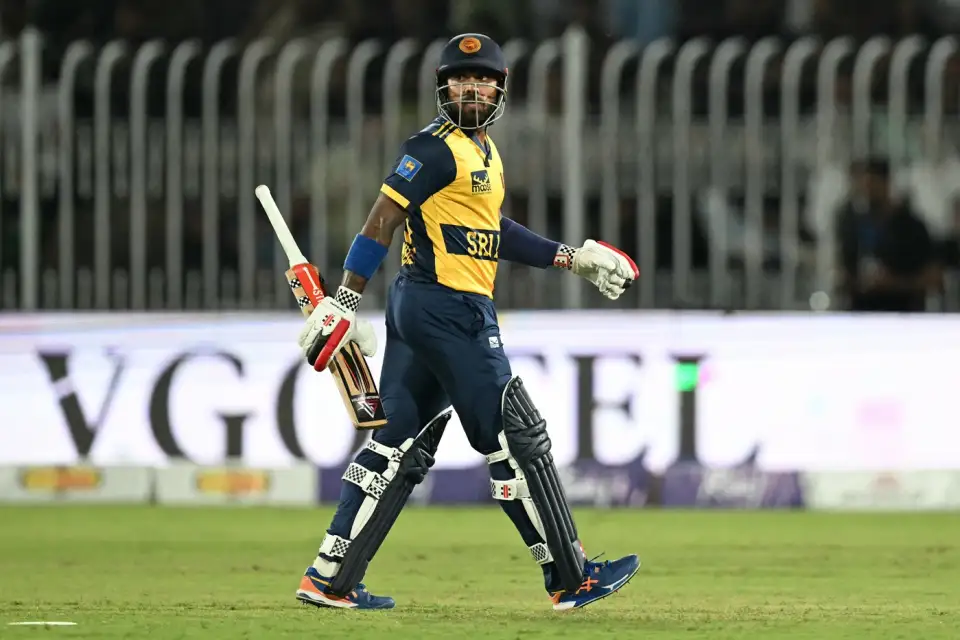
An 82-run defeat to Pakistan, a series lost with a match to spare, and a batting line-up that never looked capable of chasing 216. Sri Lanka’s latest T20I failure raises serious questions about the team’s quality, preparation and direction.
Sri Lanka’s decline in T20 international cricket is becoming increasingly difficult to ignore. The 82-run defeat to Pakistan in the second T20I in Rawalpindi on Sunday was not merely another disappointing result. It was another stark reminder of how far the national team appears to have fallen behind the demands of modern T20 cricket.
Pakistan piled up 215 for three in their 20 overs, powered by a breathtaking 96 off 51 balls from Maaz Sadaqat and an equally commanding 73 off 44 from Sahibzada Farhan. Sri Lanka, in reply, managed only 133 for seven, suffering a comprehensive defeat that handed Pakistan an unassailable 2-0 lead in the three-match series.
The margin was emphatic. More concerning, however, was the manner of Sri Lanka’s performance.
There was little evidence of a team equipped to compete with Pakistan’s power, intent or execution. Sri Lanka were outplayed with the bat, struggled to contain the opposition’s aggressive stroke-makers and once again failed to demonstrate the consistency required at international level.
A bowling attack that lost control
Sri Lanka’s decision to field first offered an opportunity to exploit the early conditions and restrict Pakistan to a manageable total. Instead, the innings developed into a demonstration of how quickly a T20 contest can get away from a bowling side that loses control of the middle and death overs.
Pakistan scored 156 runs in the final 12 overs, a staggering acceleration that left Sri Lanka with little chance of recovering.
Sadaqat was the principal architect of the assault. After a measured start, the left-hander shifted gears spectacularly, striking sixes with remarkable authority and finding boundaries against both pace and spin. His 96 was an exhibition of clean hitting, intelligent placement and an understanding of when to attack.
Farhan provided the foundation with his 73, while the partnership between Sadaqat and Hasan Nawaz further exposed Sri Lanka’s inability to stem the flow of runs once Pakistan’s batters took control.
Credit must go to Pakistan for their fearless approach. Their batters did not simply wait for bad deliveries; they forced the bowlers to defend areas of the ground that are normally considered relatively safe. Sri Lanka, by contrast, appeared to have few effective answers once the pressure mounted.
The bowling figures tell part of the story. Maheesh Theekshana conceded heavily despite claiming a wicket, while Eshan Malinga and the other bowlers struggled to prevent Pakistan from accelerating.
The problem was not simply that Pakistan batted well. It was that Sri Lanka failed to regain control during an extended period in which the innings could have been contained.
At this level, a bowling attack must possess the variations, accuracy and tactical flexibility to respond when a batter launches an assault. Sri Lanka appeared short of those answers.
A batting line-up without a convincing response
If the first innings exposed weaknesses in Sri Lanka’s bowling, the chase revealed an even more troubling lack of batting resilience.
Chasing 216 was always going to require an exceptional start, sustained aggression and meaningful partnerships. Instead, Sri Lanka stumbled to 35 for two in the powerplay and deteriorated further, reaching 64 for five by the 11th over.
Lahiru Udara, one of the few Sri Lankan batters to have shown encouraging form, fell for five. Sineth Jayawardena briefly offered some resistance with three consecutive boundaries, but his innings never developed into the sort of contribution required to challenge Pakistan’s total.
The top order failed to establish itself, and the middle order proved incapable of rebuilding the innings or launching a serious counterattack.
None of Sri Lanka’s top seven batters reached 30.
That statistic is perhaps the most damning measure of the batting failure. Against a target of 216, Sri Lanka needed at least one substantial innings, supported by contributions from the other end. Instead, wickets fell at regular intervals, leaving the lower order to manage an increasingly impossible situation.
Pakistan’s Mohammad Imran was particularly impressive, finishing with three wickets for just 11 runs in four overs. His spell dismantled Sri Lanka’s middle order and demonstrated the value of disciplined fast bowling, changes of pace and intelligent use of the crease.
Salman Mirza also made a decisive contribution as Pakistan’s quicks took five wickets between them.
Sri Lanka’s eventual total of 133 for seven was not simply the consequence of a demanding target. It reflected a batting unit that failed to adapt to the match situation.
The uncomfortable question: Where are Sri Lanka’s T20 specialists?
Sri Lanka must confront a difficult question. Does the current squad contain enough players who are genuinely equipped for modern T20 international cricket?
The format has evolved rapidly. Successful teams now combine power-hitting, flexible batting orders, high-intensity running, innovative stroke-play and bowlers who can execute specialised plans under pressure.
A respectable technique and an ability to build an innings are no longer sufficient on their own. Batters must be able to accelerate without losing control, while bowlers need reliable options when conventional plans fail.
Sri Lanka’s performances increasingly suggest a disconnect between the skills required by the modern game and those being delivered on the field.
The concern is not that every batter must score at a strike rate of 180 or that every bowler must produce an exceptional performance in every match. It is that the team lacks a consistent collective approach to high-scoring T20 cricket.
When wickets fall, there must be a plan to recover. When the opposition accelerates, the bowlers must have a strategy to respond. When a chase demands sustained aggression, the batting line-up must have players capable of delivering it.
Sri Lanka showed little of that cohesion in Rawalpindi.
Team selection, role clarity and the identification of players suited to the format deserve serious scrutiny. Are the selected batters being asked to perform roles that match their strengths? Is the team management adequately preparing for totals above 200? Are players being selected on their T20 effectiveness rather than reputation or performances in other formats?
These are legitimate questions that cannot be answered by changing one or two names in the playing XI.
Is the problem bigger than the players?
It would be unfair to place the entire burden of responsibility on the players. Individual mistakes deserve criticism, but repeated failures demand a wider examination of the system that prepares and selects the national team.
Sri Lanka Cricket must assess whether the domestic structure is producing enough players with the power, adaptability and tactical awareness required for international T20 cricket.
Domestic success does not automatically translate into international effectiveness. Players must be exposed to high-quality competition, demanding match situations and coaching that prepares them for the pace of the modern game.
Equally important is accountability. Coaches and selectors must be able to explain the team’s tactical approach, the roles assigned to individual players and the reasons behind selection decisions.
A succession of poor results cannot be dismissed as a temporary dip in form. Nor can the response be limited to promises of improvement before the next series.
The team needs a clear assessment of its weaknesses, a coherent selection policy and measurable improvements in performance.
Sri Lanka’s supporters have every right to demand more than occasional flashes of individual talent. They deserve a team capable of competing consistently against leading international opposition.
Pakistan provide a lesson Sri Lanka must learn
Pakistan’s victory was built on two outstanding batting performances and a disciplined bowling display. Sadaqat’s 96 and Farhan’s 73 showed how a strong platform can be converted into a formidable total. Imran’s three-wicket spell then ensured that Sri Lanka never had an opportunity to build momentum.
The contrast between the two teams was unmistakable.
Pakistan played with clarity and conviction. Sri Lanka appeared reactive with the ball and uncertain with the bat.
The result also raises questions about preparation for the remaining fixture and the longer-term direction of the T20 side. With the series already lost, the final match must become an opportunity to test solutions rather than simply an exercise in damage limitation.
That does not mean making changes for the sake of change. It means identifying the roles that are not being fulfilled, assessing the available alternatives and giving players clear responsibilities.
Sri Lanka need to find out which batters can consistently deliver power and acceleration, which bowlers can control the middle and death overs, and which combinations offer the best balance.
Those decisions must be based on evidence, not hope.
Time for decisive action
Sri Lanka’s 82-run defeat in Rawalpindi should serve as a wake-up call. The team cannot continue to approach T20 international cricket without demonstrating a clear understanding of how the format is played at the highest level.
The warning signs are now difficult to overlook: an inability to contain aggressive batting, repeated top-order failures, a lack of substantial partnerships and insufficient evidence of a coherent plan under pressure.
There is no single remedy. Rebuilding the side will require better role definition, sharper tactical preparation, stronger domestic development and the courage to make selection decisions based on performance and suitability for the format.
Above all, Sri Lanka Cricket must be honest about the scale of the problem.
The objective cannot simply be to avoid another heavy defeat. It must be to build a team capable of competing with the best, setting demanding targets and chasing them with conviction.
Sri Lanka have a proud cricketing history, but history offers no protection in a format that rewards innovation, execution and relentless intent.
The game has moved on. Sri Lanka must decide whether they are prepared to move with it.
The question is no longer whether Sri Lanka can produce an occasional competitive performance. It is whether the country’s cricket establishment recognises the urgency of the T20 crisis and is prepared to take the decisive action needed to reverse it.


