


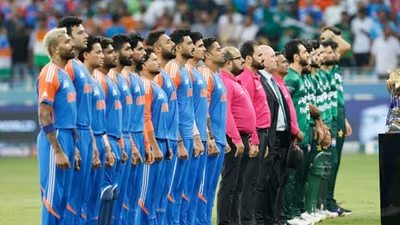
As India and Pakistan prepare to meet in Colombo on Sunday for their #T20WorldCup2026 clash, all eyes are on more than just cricket. What was supposed to be a high-voltage sporting showdown became one of the most controversial build-ups in the rivalry’s history–from boycott threats to symbolic snubs, politics has overshadowed play.
Here’s a 10-point explainer on how relations between the two teams went from tense to downright strained this season 
India vs Pakistan: How Cricket Relations Went from Bad to Worse
 Conflict sets the tone (May 2025)
A four-day conflict between the two neighbours shifted perceptions — cricket was no longer just a game.
 The handshake that never happened (Sept 14, 2025)
India captain Suryakumar Yadav skipped the pre-toss handshake with Pakistan leader Salman Agha, triggering controversy.
 No handshake even after the match
India walked off without post-match courtesies, with Yadav saying some issues were “above sportsmanship”.
 Pakistan protests match official (Sept 17)
Pakistan delayed their next match, protesting against match referee Andy Pycroft for his role in the no-handshake directive.
 Heated exchanges on the field (Sept 21)
Pakistan’s Haris Rauf and India’s Abhishek Sharma traded words amid rising tempers.
 War symbolism crosses the line
Rauf’s jet-crash gestures and celebratory theatrics by Sahibzada Farhan drew formal complaints to the International Cricket Council.
 Trophy refusal drama (Sept 28)
After winning the Asia Cup final, India refused the trophy from Mohsin Naqvi, citing his political role — delaying the ceremony.
 Women’s teams also drawn in (Oct 5)
India’s Harmanpreet Kaur and Pakistan’s Fatima Sana also skipped traditional handshakes at the Women’s World Cup.
 ICC sanctions follow (Nov 4)
The ICC fined and penalised players from both sides, including Jasprit Bumrah, citing conduct that brought the game into disrepute.
 Boycott threat before the T20 World Cup (Jan–Feb 2026)
Pakistan’s government initially announced a boycott of the India match– only to reverse the decision amid global pressure just days later.
 What this means for Sunday:
Expect a charged atmosphere in Colombo, where every ball will carry the echoes of months of off-field tension. This is more than a match — it’s the latest chapter in a rivalry shaped as much by geopolitics as by cricket.


