


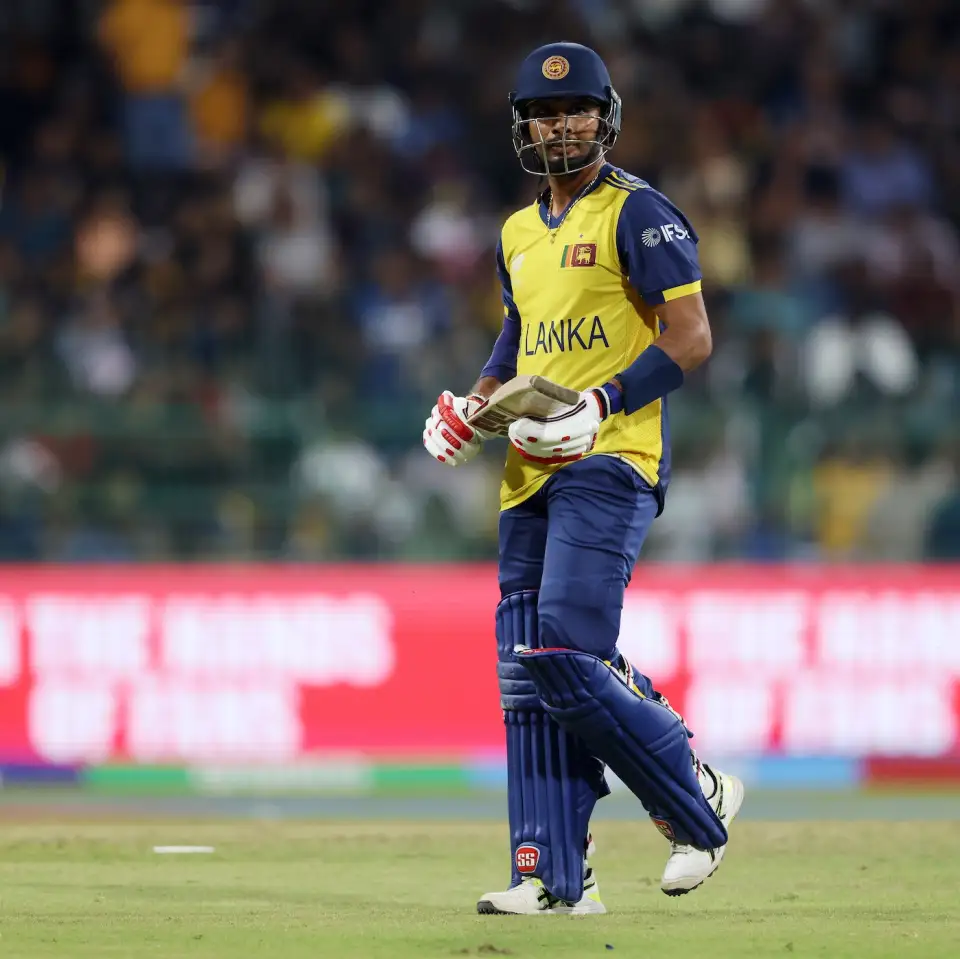
Sri Lanka’s ICC Men’s T20 World Cup campaign ended not with resistance or redemption, but with resignation. A crushing 61-run defeat to New Zealand at the R. Premadasa Stadium confirmed their elimination from semi-final contention, leaving disappointment, unanswered questions, and a captain openly acknowledging deep-rooted failures.
Chasing 169, Sri Lanka staggered to a humiliating 107, producing one of their poorest batting displays in a home World Cup. What began with optimism quickly dissolved into a familiar pattern of tactical errors, fragile batting and missed opportunities.
“We feel very sorry about this,” Shanaka said. “For the spectators, I don’t have anything to tell. We have not given them any win that they can be happy about.”
Sri Lanka’s troubles began at the toss. Expecting a fresh pitch to favour batting, the hosts chose to bat first only to discover a slow surface that increasingly aided spin.
“Before the match we thought it would be very good,” Shanaka explained. “We didn’t think the spinners would work this much there. Unfortunately, what we wanted didn’t happen. It started to act like a usual cutting wicket in Khettarama.”
The misjudgment proved costly. Sri Lanka failed to adjust their approach, managing just one six and eight boundaries throughout the innings, an alarming statistic in modern T20 cricket.
While Shanaka admitted Sri Lanka lacked power hitters, his explanation also highlighted uncertainty in strategy.
“Yes, there is a lack of power hitting when we look at Sri Lanka overall,” he said. “But on wickets like this, sweeps and reverse sweeps are more important.”
Modern T20 teams adapt without losing scoring intent. Sri Lanka, however, appeared caught between methods, unable to attack or accumulate effectively.
If the batting collapse placed Sri Lanka on the back foot, the final four overs ended the contest. With New Zealand under pressure earlier, Sri Lanka conceded 70 runs at the death as Mitchell Santner and McConchie exploited poor execution.
“They targeted the short boundary,” Shanaka admitted. “We must give credit to Santner and McConchie because they waited until the 16th over to accelerate. Everything went wrong for us.”
According to the captain, the issue was not planning but execution.
“It’s totally a mental thing,” he said. “Players know what to execute, but sometimes they misread situations.”
Mental lapses have repeatedly defined Sri Lanka’s campaign, turning manageable situations into decisive defeats.
Perhaps the most concerning admission came when Shanaka addressed the physical condition of the squad.
“I don’t think the physical fitness is up to the maximum level,” he said. “In this World Cup we have about four to five injuries. Other teams are way ahead of us when considering fitness levels.”
For a team frequently disrupted by injuries across major tournaments, the statement reinforced long-standing concerns about conditioning standards and preparation.
Shanaka stressed that fitness must become “unnegotiable” if Sri Lanka hope to compete consistently at the highest level.
The captain also spoke about the psychological pressure created by criticism surrounding the team.
“As players it’s very hard for us to control the outside noise,” he said. “Most of the time we mainly hear negative stuff.”
Yet he acknowledged that supporters had reason to feel frustrated.
“Sometimes we don’t do anything fair for the expectations of the spectators. Their negativity is fair.”
Having led Sri Lanka through multiple World Cups without reaching a semi-final, Shanaka admitted his future as captain remains uncertain.
“I have no idea how long I will be captain. That is decided by the selectors,” he said. “I had many good decisions and I have made mistakes as well.”
A home World Cup was expected to mark Sri Lanka’s resurgence. Instead, it exposed recurring weaknesses in batting, fitness, planning and mental resilience under pressure.
This was not simply a defeat. It was a stark reminder that Sri Lanka’s challenges run far deeper than one disappointing night.


