


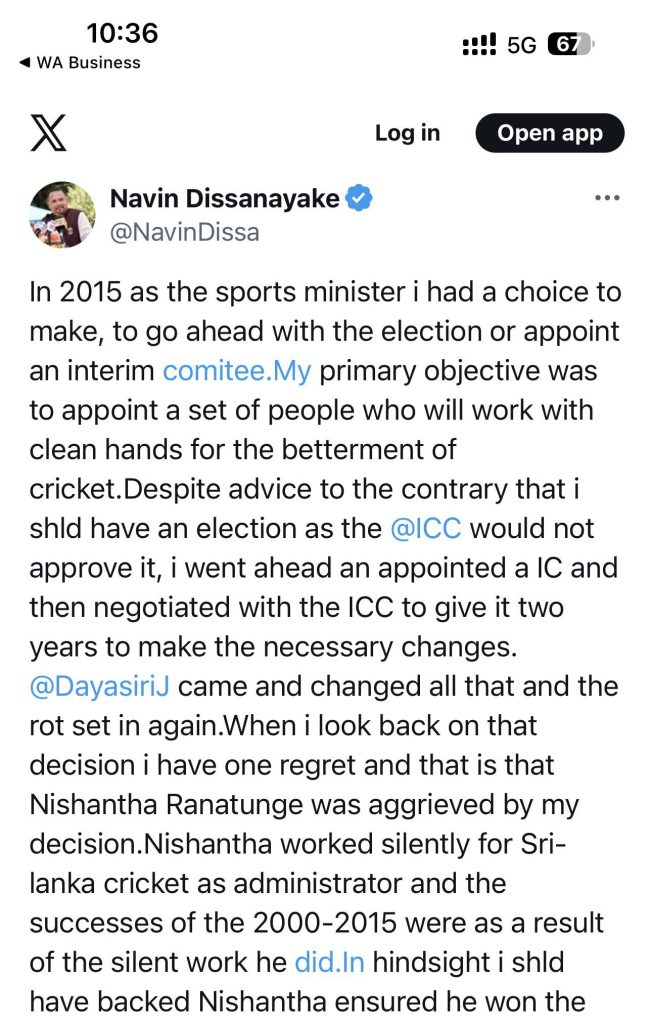
In a striking admission that has stirred renewed debate across the cricketing fraternity, former Sports Minister Navin Dissanayake has conceded that one of the biggest mistakes of his tenure was preventing Nishantha Ranatunga from being elected President of Sri Lanka Cricket in 2015.
The statement, posted on X, comes at a time when Sri Lankan cricket is once again under intense scrutiny following a disastrous T20 World Cup campaign that has triggered public anger and protest. His reflections have not only reopened an old administrative chapter but also revived questions about how differently the sport’s trajectory might have unfolded.
The Fork in the Road
According to Dissanayake, 2015 presented him with a critical choice: allow the scheduled election at Sri Lanka Cricket to proceed or dissolve the process and appoint an Interim Committee. He chose the latter.
Despite advice cautioning that the International Cricket Council would disapprove of political interference, Dissanayake went ahead with the Interim Committee, later negotiating with the ICC for a two-year window to implement structural reforms.
His reasoning at the time, he says, was driven by a desire to install administrators who would “work with clean hands” for the betterment of the game. Yet, with the benefit of hindsight, he now believes that decision cost Sri Lanka an opportunity for stability.
“I have one regret,” Dissanayake admitted, referring to the fact that Nishantha Ranatunga was aggrieved by the move. “In hindsight I should have backed Nishantha and ensured he won the election without any problems with the ICC.”
The Ranatunga Era: A Period of Achievement
From 2009 to 2015, Nishantha Ranatunga served as Secretary under three SLC presidents — DS de Silva during an Interim Committee phase, followed by Upali Dharmadasa and Jayantha Dharmadasa through elected administrations.
It was a six-year stretch that coincided with remarkable on-field success.
Sri Lanka reached five major tournament finals during that period:
- Runners-up at the 2009 T20 World Cup in England
- Runners-up at the 2011 ICC Cricket World Cup in India
- Runners-up at the 2012 T20 World Cup in Sri Lanka
- Champions at the 2014 T20 World Cup
- Champions at the 2014 Asia Cup
While players and coaches rightfully commanded headlines, administrators worked largely behind the scenes. Dissanayake now credits Ranatunga’s “silent work” as a key pillar of that golden run.
By 2015, Ranatunga was widely expected to ascend to the presidency of Sri Lanka Cricket through election. Instead, the process was cancelled, and an Interim Committee was installed — a decision that many believe altered the administrative continuity of the board.
Political Realities and Administrative Consequences
Dissanayake has also cited the political climate of the time as a constraining factor. According to him, the environment did not permit him to fully support Ranatunga’s election. He further suggested that future Sports Ministers would think twice before appointing Interim Committees, given the ICC’s strong stance against government interference.
The ICC has consistently maintained that cricket boards must operate independently of political control. Any deviation risks sanctions, including suspension. Sri Lanka itself has faced such tensions in the past.
The former Minister also pointed to subsequent administrative changes under then Sports Minister Dayasiri Jayasekera, claiming that instability returned after the Interim Committee phase ended.
A Timely Confession
Why does this matter now?
Because Sri Lankan cricket is once again at a crossroads. A faltering national side, structural uncertainty, and questions over governance have created an atmosphere eerily reminiscent of past crises. Dissanayake’s confession is not merely a reflection on a past misstep; it is an implicit acknowledgment that administrative stability matters as much as on-field talent.
The period between 2009 and 2015 demonstrated that cohesive governance and clear direction can translate into consistent global competitiveness. Since then, however, Sri Lanka’s fortunes have fluctuated sharply.
Was 2015 the moment when continuity was sacrificed? That is the question now circulating among cricket observers.
Lessons for the Future
Regret, in politics and sport alike, often arrives too late to change history. Yet public acknowledgment of error can serve as a catalyst for introspection. If anything, Dissanayake’s remarks underline a broader truth: cricket administration in Sri Lanka cannot afford to be driven by short-term political calculations.
As the game attempts to rebuild, stakeholders would do well to remember that sustainable success requires institutional strength, transparent governance, and insulation from political turbulence.
Whether Nishantha Ranatunga’s presidency would have guaranteed a different future remains a matter of speculation. But what is certain is this — 2015 was a pivotal year. And more than a decade later, its consequences are still being debated.


